Overview
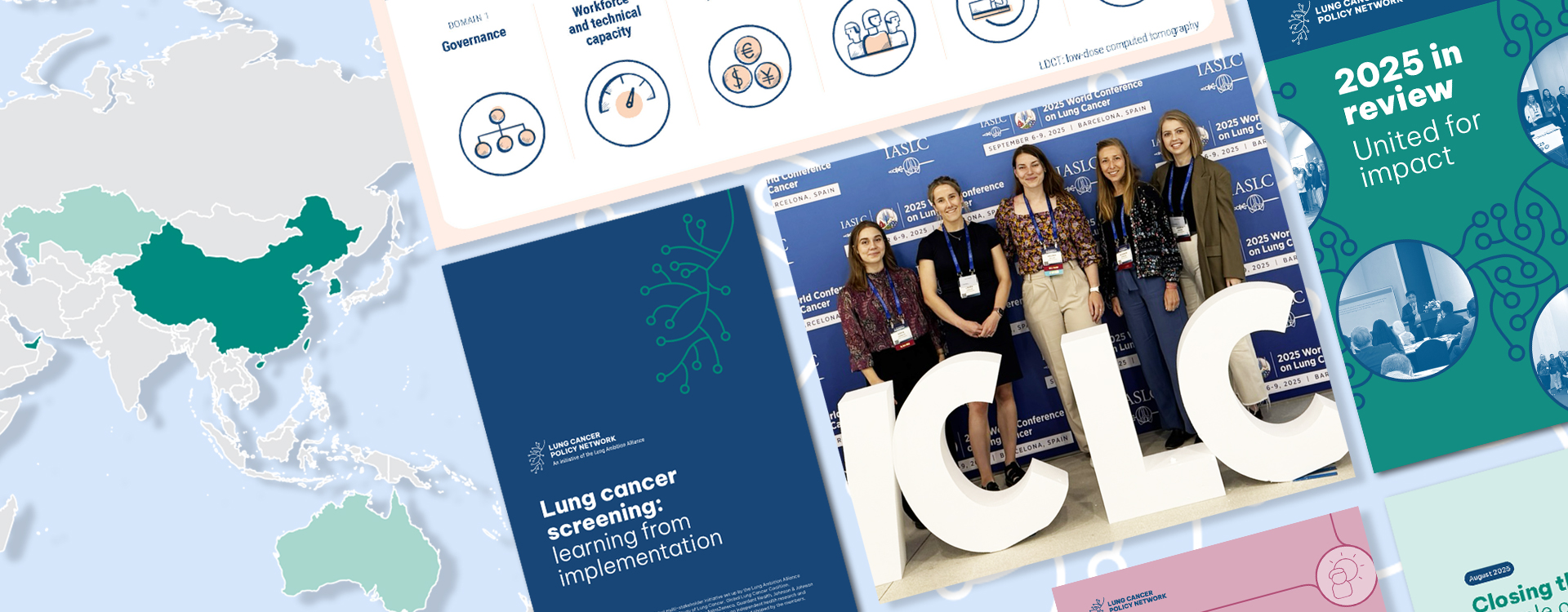
As the leading voice of lung cancer policy, the Lung Cancer Policy Network – a multi-year, multi-funder, global alliance driving the political prioritisation of lung cancer – delivers evidence-informed and consensus-driven policy recommendations on screening, earlier detection and optimal care. HPP founded the Network in 2021 and continues to act as Secretariat.

Hans-Ulrich Kauczor, Network member
The challenge
Lung cancer remains the leading cause of cancer-related deaths globally, and is predominantly diagnosed and treated at a late stage. Decades of rigorous evidence show that earlier detection and optimal care can significantly improve outcomes and save lives. Yet national commitment to this remains limited, with a gap between proven science and public health policy.
What we achieved
A global hub for shared learning and advocacy
- Since HPP established the Network in 2021, it has grown to over 120 expert members, including 37 member organisations and 8 industry partners.
- The Network has held multidisciplinary workshops in several regions, including Africa, Asia Pacific and Europe; in person events and dialogues to support national implementation.
Generating consensus-driven, evidence-based policy insights
- The Network’s outputs translate complex evidence into practical tools for policymakers and health systems, including global policy reports and policy summaries on screening, optimal care and diagnosis; implementation toolkits and an interactive map of screening to support national roll-out.
- The Network’s outputs are widely used by policymakers, advocates and leaders to inform strategy and programme design.
Tackling policy barriers to effective implementation
- The Network’s tools and frameworks actively support countries to move from policy commitment to implementation. The screening implementation framework has informed programme development in regions including the Middle East, Africa and Central Asia.
- Countries including Australia, the UK and Kazakhstan are using Network insights to assess system readiness, design screening pathways and refine policy approaches.
- The Network convenes stakeholders to translate evidence into action, including regional workshops to define practical steps for screening implementation, and cross-country exchange of best practice and lessons learned.
Advancing policy commitment to transform care and outcomes
- The Network contributes to and helps shape major global policy developments, including the integration of lung cancer in the global lung health resolution adopted at the World Health Assembly; and engagement in international processes and initiatives that define the future of lung cancer policy (e.g. global reports, consensus statements).
- The Network helps ensure that global commitments translate into national action and measurable progress.
- In 2025, HPP led the development of a five-year strategy for the Network, with an emphasis on international collaboration to drive policy change through to implementation with tangible benefits to patients.
Core resources

Website
Lung Cancer Policy Network
Digital tools
Interactive map of lung cancer screening

Project information
The Lung Cancer Policy Network is a global, multidisciplinary group including clinicians, researchers, patient organisations and industry partners. Its activities and outputs are supported by its major funders Amgen, AstraZeneca, Bristol Myers Squibb Foundation, MSD, Pfizer and Siemens Healthineers; and Johnson & Johnson as a minor funder. Lilly is an arm’s‑length major funder with no influence or control over the Network or its outputs. Secretariat is provided by The Health Policy Partnership, an independent health research and policy consultancy. All Network outputs are non-promotional, evidence based and shaped by the members, who provide their time for free.
Get in touch
If you want to find out more about our work on behalf of the Lung Cancer Policy Network, contact Helena Wilcox, Associate Director of Research and Policy; Programme Lead, Lung Cancer Policy Network.

Related work
Project

The Heart Failure Policy Network
Project

Transforming lung cancer care
Project
